Attention
This page of the FRICOSIPY user manual is currently under active development!
Surface Mass Balance
The surface mass balance (SMB) is directly coupled to the surface energy balance and can be described by the following equation:
where \(\dot{m}_{\text{ precipitation}}\) is the precipitation (snowfall or rain) mass flux, \(\dot{m}_{\text{ deposition}}\) , \(\dot{m}_{\text{ condensation}}\) , \(\dot{m}_{\text{ evaporation}}\) & \(\dot{m}_{\text{ sublimation}}\) are the turbulent mass fluxes associated with latent heat exchange and \(\dot{m}_{\text{ melt}}\) is the surface melt mass flux (all units m w.e.).

Note
By convention, positive values \((+)\) represent mass accumulated on the glacier surface; negative values \((-)\) depict mass ablated from the glacier surface.
Precipitation

Surface Melt

where \(Q_{\text{melt}}\) is the melt energy flux, \(dt\) is the model time step (s), \(\rho_{w} = 1000\) kg m\(^{-3}\) is the density of water and \(L_{f} = 3.34 \times 10^{5}\) J kg\(^{-1}\) is the latent heat of fusion.
Exemplar Surface Mass Balance
The Surface Mass Balance (SMB) illustrates the mass exchange occuring at the surface – either accumulation \((+)\) or ablation \((-)\). In contrast to the energy balance, the monthly mass fluxes do not need to be balanced. Figure 4 shows an exemplar point surface mass balance for Colle Gnifetti at the summit of the Grenz glacier, Valais, Switzerland produced from the FRICOSIPY model. For Colle Gnifetti, being situated in a high-altitude accumulation area, the net mass exchange is positive.
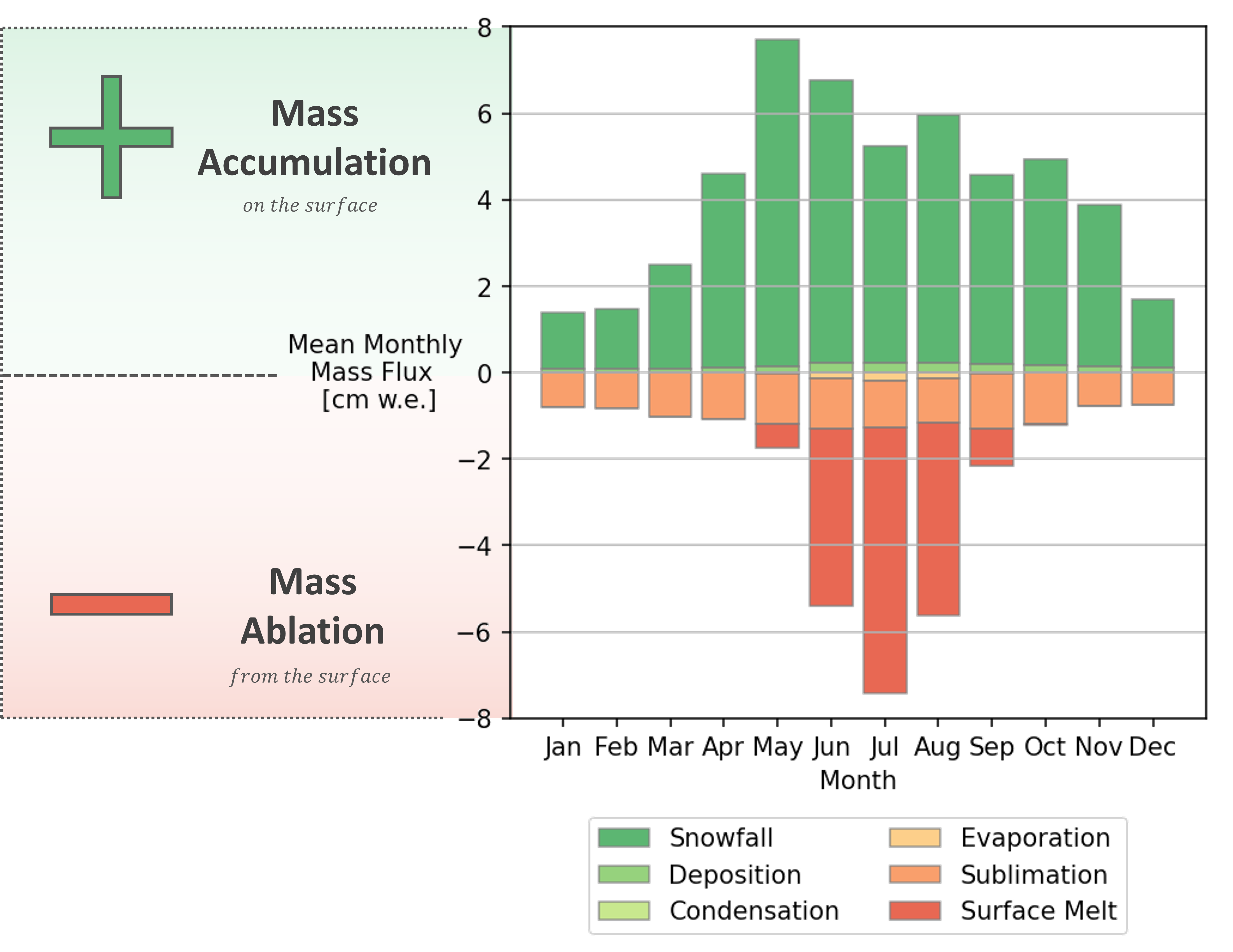
Note
The FRICOSIPY result viewer contains a plotting function that can automatically produce a surface mass balance graph (akin to the figure above) for any output dataset.